
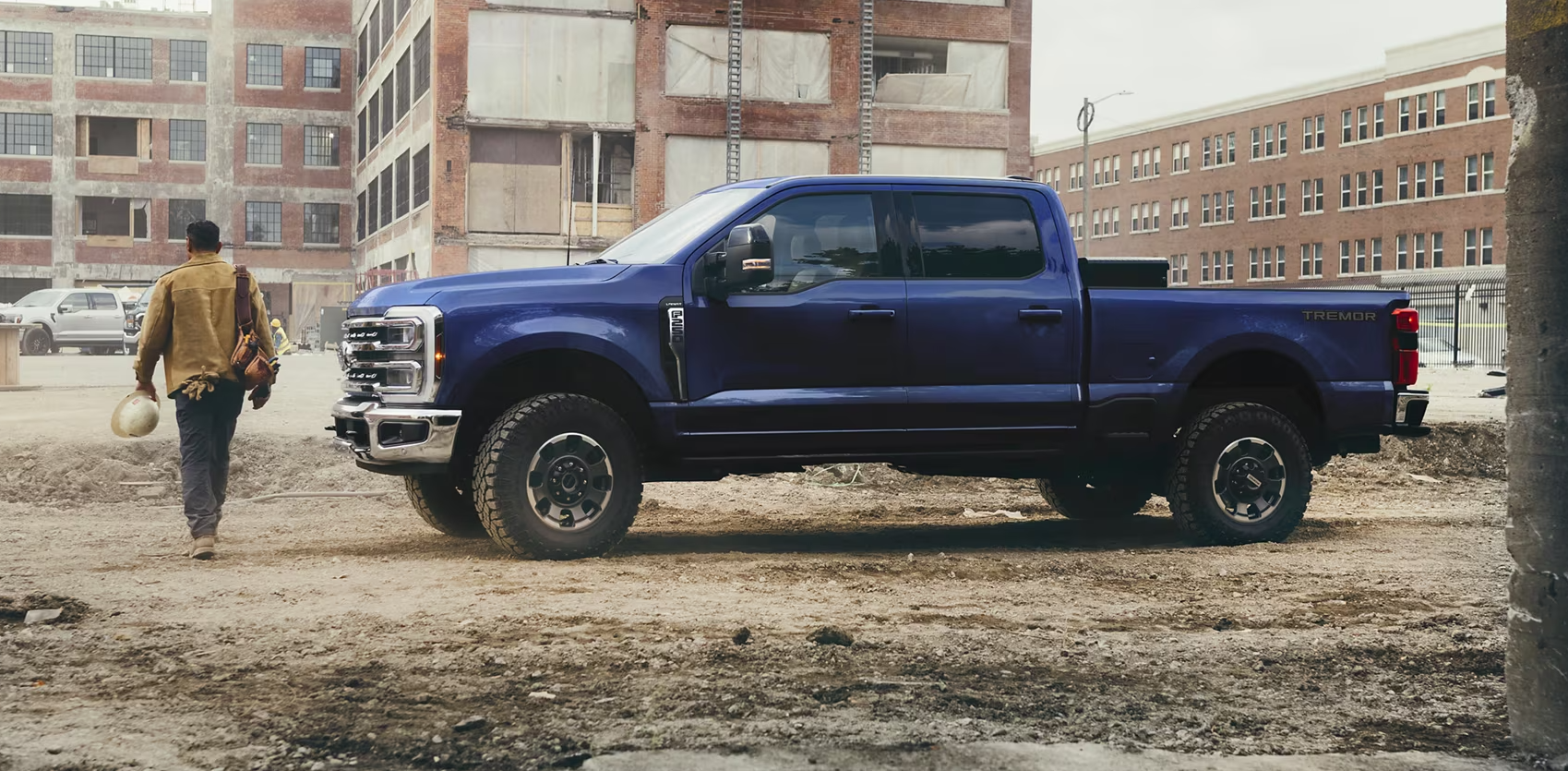
Picking the right heavy-duty truck comes down to understanding what’s under the hood and how that translates to real pulling power. The 2026 Ford Super Duty lineup gives you that clarity with three distinct engine options and configurations built to match your trailer to your truck bed.
Whether you’re hauling construction equipment during the week or a fifth-wheel camper on weekends, getting your Super Duty towing figured out starts with knowing your numbers and ends with confidence on the road.
2026 Ford Super Duty Towing Capabilities Overview
Ford Super Duty towing capacity swings dramatically between the F-250, F-350, and F-450 models, giving you room to right-size your investment. These trucks pack advanced towing tech that goes beyond raw numbers. Integrated trailer sway control, adaptive cruise with trailer brake integration, and Pro Trailer Backup Assist make managing heavy loads feel intuitive instead of nerve-wracking.
Smart features team up with robust frames and suspension systems tuned specifically for load management. The 2026 Ford Super Duty towing capabilities excel in commercial settings and personal use alike. Contractors working northern Westchester County job sites love the consistent performance, while recreational towers appreciate the stability during long highway hauls. Each model tier bumps up payload limits and towing thresholds, so you can find a configuration that handles your heaviest anticipated load.
Ready to experience this capability firsthand? Schedule a test drive at our Brewster showroom to feel the difference these powertrains make under real towing conditions.
Engine Options: The Heart of Super Duty Towing Performance
Your engine choice shapes how your Super Duty handles weight. According to Ford Motor Company specifications, all Super Duty engines pair with a 10-speed TorqShift automatic transmission. Gas engines use the TorqShift-G variant, while diesel engines use the TorqShift variant, both engineered to smooth out power delivery across the full range of Super Duty applications. These advanced transmission systems smooth out power delivery, especially crucial when merging onto highways with thousands of pounds trailing behind.
Here’s how the 2026 Super Duty engine lineup breaks down:
| Engine | Horsepower | Torque | Best Use Case |
| 6.8L V8 Gas | 405 hp | 445 lb-ft | Entry-level reliability, moderate towing |
| 7.3L V8 Gas | 430 hp | 485 lb-ft | Best-in-class gas power, equipment trailers |
| 6.7L Power Stroke Diesel | 475 hp | 1,050 lb-ft | Sustained heavy loads, daily towing |
| 6.7L High-Output Diesel | 500 hp | 1,200 lb-ft | Maximum capability, commercial use |
Getting familiar with Ford Super Duty engine options helps you balance upfront costs against operating expenses over the truck’s lifetime. Gas engines typically cost less initially and keep maintenance straightforward, while diesel powerplants deliver superior torque and fuel efficiency under sustained heavy loads.
6.8L V8 Gas Engine: Capable Standard Power
The 6.8L V8 gas engine works for drivers who need dependable towing without diesel complexity. This engine handles daily work truck duties and moderate towing tasks with straightforward reliability. You’ll find it suits contractors running between job sites with equipment trailers or small business owners who occasionally haul materials.
Maintenance stays simple with conventional oil changes and familiar service procedures. The engine delivers solid power for F-250 configurations when your typical loads stay within moderate weight ranges. It’s the most affordable entry point into Super Duty ownership while maintaining Ford’s reputation for durability.
7.3L V8 Gas Engine: The Gas-Powered Workhorse
The 7.3L V8 engine earns its nickname by combining 430 horsepower with 485 lb-ft of torque. This gas-powered option appeals to towers who want diesel-like capability without the diesel price tag or maintenance requirements. The engine’s design emphasizes displacement over modern turbocharging, resulting in linear power delivery that feels predictable when managing heavy trailers.
You’ll appreciate the 7.3L’s performance when towing landscaping equipment, horse trailers, or medium-duty construction loads. The engine produces strong low-end torque that helps you get moving from a standstill with weight behind you. Its pushrod design keeps things mechanically simpler than overhead cam configurations, potentially cutting long-term repair costs.
6.7L Power Stroke Diesel: Standard and High-Output Configurations
The 6.7L Power Stroke diesel engine represents the pinnacle of Ford Super Duty towing performance. The standard output variant delivers 475 horsepower and 1,050 lb-ft of torque that makes short work of heavy loads while maintaining reasonable fuel efficiency. Step up to the High-Output configuration, and you’re looking at 500 horsepower and 1,200 lb-ft of torque that redefines what’s possible in the heavy-duty segment.
Ford F-250 diesel towing capacity reaches impressive heights with this engine, while F-350 and F-450 models push boundaries even further. The Power Stroke’s ability to maintain power at altitude and in extreme temperatures makes it the choice for towers who can’t afford performance compromises. Maintenance costs run higher than gas engines, but the trade-off comes in superior fuel efficiency and resale value that often justifies the investment.
How Configuration Choices Shape Your Towing Capacity
The heavy-duty truck towing capacity you’ll actually achieve depends on more than engine selection. Your drivetrain configuration, axle ratio selection, and hitch type work together to determine real-world numbers.
Here’s how maximum capacity breaks down by model according to Ford Motor Company:
| Model | Max Towing | Max Payload | Best Configuration |
| F-250 (SRW) | Up to 22,500 lbs (7.3L gas, gooseneck) | Up to 8,000 lbs (gas HD Payload Package) | Gooseneck required for maximum ratings |
| F-350 (SRW/DRW) | Up to 40,000 lbs (6.7L HO Diesel, 40K Gooseneck Tow Package) | Up to 8,000 lbs (gas HD Payload Package, specific configurations) | Gooseneck required for maximum ratings |
| F-450 (DRW) | Up to 40,000 lbs (6.7L HO Diesel, 40K Gooseneck Tow Package required) | Up to 6,482 lbs | Best-in-class diesel gooseneck |
Two-wheel drive configurations typically offer slightly higher towing ratings than four-wheel drive equivalents because of reduced weight and drivetrain losses. However, four-wheel drive delivers crucial traction advantages when launching heavy loads on slick surfaces or navigating job sites.
Cab configuration also plays into the equation, with crew cabs adding weight that reduces available payload compared to regular or SuperCab models. Bed length influences where your fifth-wheel or gooseneck hitch mounts, affecting weight distribution and turning clearance. When you’re ready to explore specific configurations, browse our 2026 Ford Super Duty inventory to see what’s currently available.
Drivetrain, Axle Ratio, and Hitch Type Explained
Axle ratios determine how your engine’s power translates to wheel rotation. Numerically higher ratios like 4.30 provide better acceleration and hill climbing with heavy loads on northern Westchester County’s winding, hilly terrain. Lower numerical ratios like 3.55 favor fuel economy and highway cruising but sacrifice some pulling power.
Hitch type dramatically affects how weight transfers to your truck’s frame. Conventional ball hitches work fine for lighter loads but limit capacity compared to fifth-wheel or gooseneck configurations. F-250 gooseneck towing capacity exceeds conventional ratings because weight sits over the rear axle rather than behind it. This placement improves stability and allows higher tongue weights without overwhelming rear suspension components.
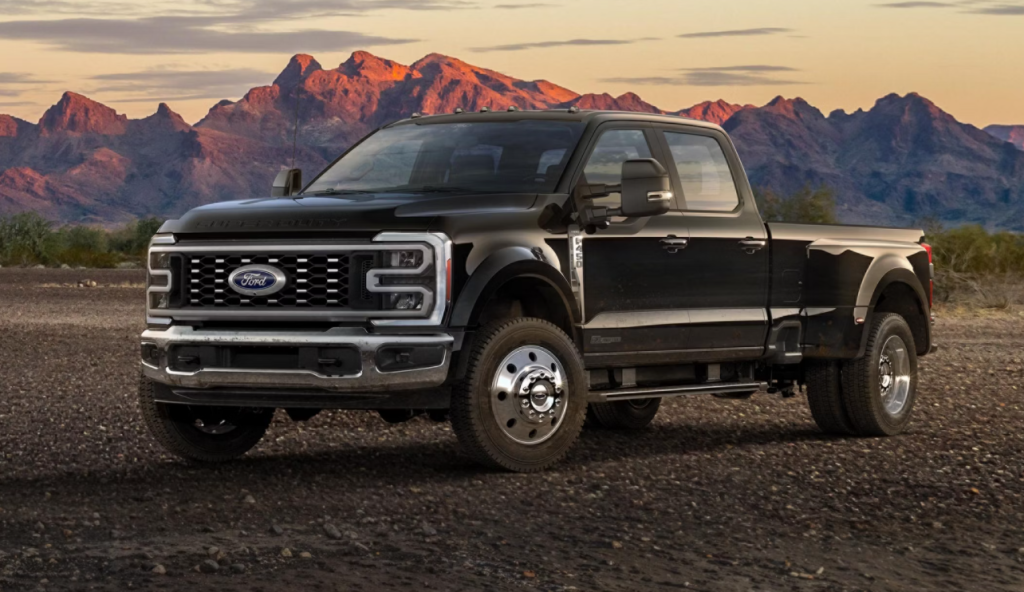
Single Rear Wheel (SRW) configurations offer better maneuverability for daily driving, while Dual Rear Wheel (DRW) setups provide greater stability and higher towing/payload capacity through improved weight distribution.
Heavy-Duty Towing Terms in Plain English
Understanding towing terminology helps you match truck to trailer safely:
- GCWR (Gross Combined Weight Rating): Maximum combined weight of truck plus trailer plus all cargo and passengers. This is the absolute limit you cannot exceed.
- Payload: Maximum weight safely added to your cargo area. Remember that tongue weight counts against payload when towing.
- Tongue Weight: Downward force at the hitch connection. Should be 10% of total loaded trailer weight for conventional hitches, and 15% for fifth-wheel and gooseneck setups.
Maximum trailer weight ratings assume optimal configuration with weight-distributing hitches where applicable. Understanding these relationships prevents overloading scenarios that compromise safety and potentially void warranties.
Choosing Between F-250, F-350, and F-450 for Your Needs
The F-250 suits buyers who need serious capability without stepping into commercial-grade territory. It delivers strong towing capacity while maintaining a ride quality acceptable for daily driving. The 2026 Ford F-250 towing capacity handles most recreational trailers and small business hauling requirements. Registration and insurance costs typically run lower than F-350 options, making total ownership expenses more manageable.
The F-350 hits the sweet spot for serious towers who still want reasonable drivability. The 2026 Ford F-350 towing capacity jumps significantly over F-250 numbers, especially in dually configurations. You’ll find this model favored by contractors with heavy equipment, RV enthusiasts with large fifth-wheels, and anyone who regularly approaches maximum ratings.
The F-450 exists for those who need absolute maximum capability. F-450 towing numbers reach territory where you’re competing with medium-duty commercial trucks. This model makes sense for heavy equipment haulers, large livestock operations, and commercial applications where payload and towing capacity directly impact profitability.
Quick Checklist: Sizing Your Super Duty to Your Trailer
- Weigh your trailer fully loaded (don’t rely on manufacturer estimates)
- Add 15-20% to that number if considering a fifth-wheel or gooseneck setup for tongue weight
- Check your desired truck’s payload capacity and subtract passenger weight, toolboxes, and cargo you’ll carry regularly
- Compare remaining payload against tongue weight requirement
- Verify the truck’s maximum towing rating exceeds the trailer weight with comfortable safety margin
- Consider towing at altitude, in extreme temperatures, or through mountainous terrain (all reduce effective capacity)
- Review axle ratio options to ensure adequate performance for your typical routes
- Factor in whether you need four-wheel drive for launch traction or can save weight and cost with two-wheel drive
Find Your Perfect 2026 Ford Super Duty at Brewster Ford
Next Steps to Match Truck to Trailer
We understand that matching the right truck to your trailer involves more than reading spec sheets. Our team will walk you through real-world scenarios that matter to your specific hauling needs, whether you’re pulling construction equipment through local job sites or heading to regional lakes with your boat.
Contact our team to discuss which Super Duty configuration delivers the capability you need. We’ll help you calculate specific towing requirements based on your actual loads.
Browse our new Ford inventory to see current stock and available options across the F-250, F-350, and F-450 lineup.
Visit our showroom at 1024 Route 22 in Brewster, call our sales team at 845-205-7019, or reach our service department at 845-205-7086. As the dedicated Ford store within the Volz Auto Group network, we offer access to both new inventory and quality used Super Duty trucks, plus on-site financing and factory-trained technicians to keep your truck work-ready for years to come.
Note: Towing capacity varies by configuration. We recommend verifying specific ratings with our team based on your exact truck specifications.
Connect with us


- May 2026
- April 2026
- March 2026
- February 2026
- January 2026
- December 2025
- November 2025
- October 2025
- September 2025
- August 2025
- July 2025
- June 2025
- May 2025
- April 2025
- March 2025
- February 2025
- January 2025
- December 2024
- November 2024
- October 2024
- September 2024
- August 2024
- July 2024
- June 2024
- May 2024
- April 2024
- March 2024
- February 2024
- January 2024
- December 2023
- November 2023
- October 2023
- September 2023
- August 2023
- July 2023
- June 2023
- May 2023
- April 2023
- March 2023
- February 2023
- January 2023
- December 2022
- November 2022
- October 2022
- September 2022
- August 2022
- July 2022
- June 2022
- May 2022
- April 2022
- March 2022
- February 2022
- November 2021
- October 2021
- September 2021
- January 2021
- February 2017
- January 2017
- December 2016