

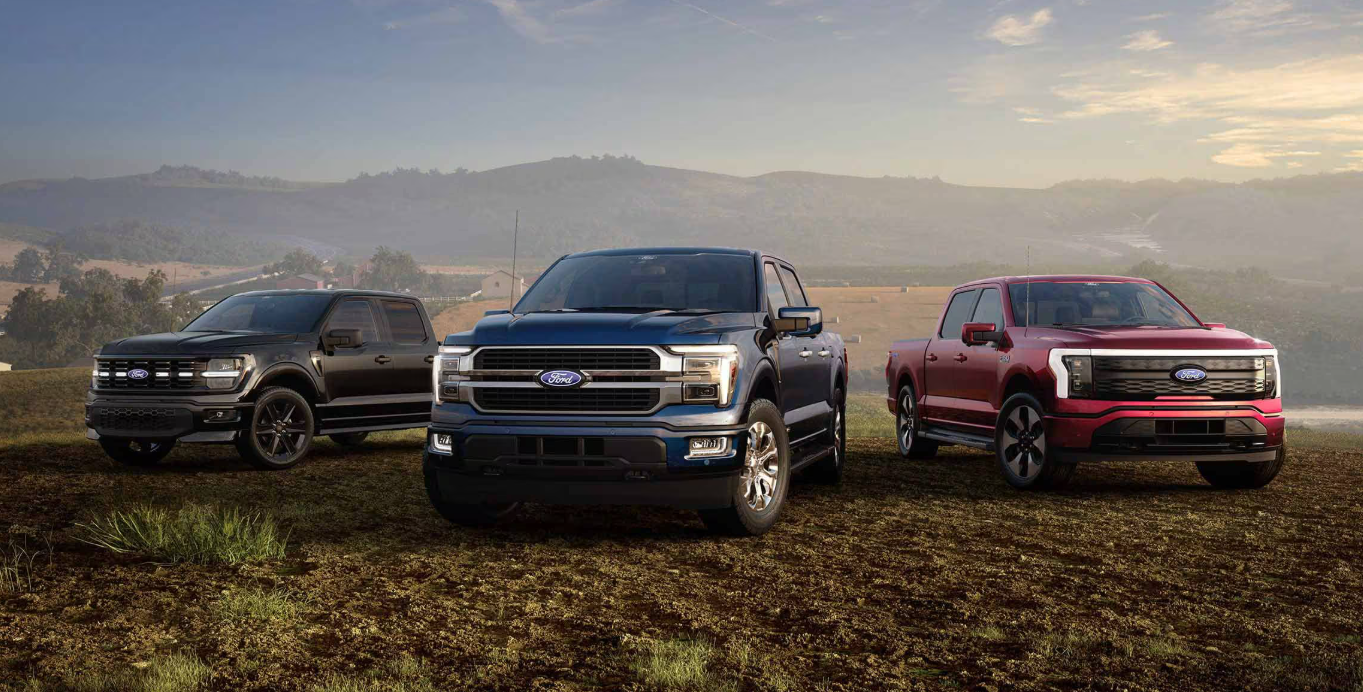
The Ford F-150 has been America’s best-selling truck for 48 consecutive years, and that record isn’t an accident. What started as a no-frills work truck built for farmers, contractors, and laborers has become a genuine showcase for automotive engineering and a reflection of how American priorities have shifted over the decades. If you’re weighing a truck purchase right now, understanding how the F-150 got here makes it a lot easier to appreciate what you’re actually getting. Browse our new Ford F-150 models in Brewster to see how far this truck has come.
The F-150’s evolution didn’t happen overnight. It came through deliberate decisions, bold engineering choices, and a genuine read on what drivers actually need. That history tells you a lot about the truck itself.
The Early Years: Built for Labor, Designed for Durability (1948–1974)
Ford’s truck history stretches back to 1917, but the version most drivers recognize starts in the postwar era, when America’s booming economy created a surge in demand for practical work vehicles.
The F-1 Lays the Foundation
The modern F-Series lineage kicked off in 1948 with the F-1. These early trucks weren’t trying to impress anyone. The engineering was straightforward: a sturdy frame, a reliable inline-six engine, and a cab designed entirely around function. Simple durability was the goal, and it resonated with buyers who needed something they could count on every single day.
The F-Series became a family of trucks rather than a single model, offering different payload ratings and configurations for different working needs. That flexibility was baked into Ford truck DNA from the very beginning. A meaningful step came in 1954 with the transition from a flathead V-8 to an OHV V-8, delivering noticeably improved power and efficiency for drivers who pushed their trucks hard.
Twin I-Beam Suspension Changes the Ride
By the fifth generation (1967–1972), Ford had introduced Twin I-Beam independent front suspension. Drivers who’d dealt with punishing rides on job sites and rural roads suddenly had a truck that could absorb the abuse without transmitting all of it through the steering wheel. Handling improved and daily driving became meaningfully more comfortable, without sacrificing toughness.
The sixth generation (1973–1979) brought crew cab expansion, making the F-Series practical enough to haul a full crew to a job site and a family on weekends. That blend of utility and versatility would define the F-150 for decades to come.
The F-150 Name Is Born and the Modern Pickup Takes Shape (1975–1996)
By the mid-1970s, federal regulations were tightening, and Ford’s response produced one of the most pivotal moments in the truck’s history.
Why Ford Created the F-150
The F-150 name arrived in 1975, positioned strategically between the lighter F-100 and the heavy-duty F-250. Emissions regulations at the time applied more stringently to heavier trucks, so the new F-150 hit a sweet spot: serious capability while retaining light-truck GVWR status. Buyers got more hauling ability without the regulatory headaches that came with heavier commercial models. The F-100 was discontinued entirely by the early 1980s, and the F-150 became the foundation of the entire lineup.
The Style Shift of the 1980s
The eighth-generation redesign in 1987 swapped the squared-off silhouette of earlier trucks for smoother, more aerodynamic lines. The windshield raked more aggressively, panels curved instead of cutting at sharp angles, and the result was a truck that performed better aerodynamically and pulled in a broader audience. Style had entered the conversation. It never left.
Performance Redefined: EcoBoost, Aluminum, and the Tech Revolution (1997–Present)
The late 1990s through today represent the most dramatic chapter in the F-150’s story. Ford didn’t just refine the truck during this era. It fundamentally reimagined what a pickup could be.
Power Upgrades Through the 2000s
The tenth generation (1997–2004) introduced the 4.6L Triton V8, alongside a 5.4L Triton V8. The eleventh generation (2004–2008) pushed further with the Triton 5.4L V8, and also debuted the FX4 off-road trim for buyers who needed real capability beyond pavement. Then came the twelfth generation (2009–2014), which introduced the Raptor with a 411-hp V8 and purpose-built off-road hardware.
EcoBoost Proves Power and Efficiency Can Coexist
In 2011, Ford introduced the EcoBoost twin-turbo V6, producing power comparable to a traditional V8 with better fuel efficiency through turbocharging and direct injection. Skeptics were loud. Real-world performance answered them.
The EcoBoost could tow heavy loads and handle demanding terrain without the fuel consumption penalty of a larger engine. Current EcoBoost output reaches up to 450 hp, and the powertrain genuinely shifted the industry’s thinking about turbocharged engines in trucks.
The Aluminum Body Gamble
The 2015 F-150 may be the single most debated redesign in pickup history. When Ford confirmed the thirteenth-generation model would use an aluminum alloy body instead of traditional steel, critics questioned durability and competitors ran ads mocking the decision. What followed told a very different story.
The high-strength aluminum alloy stripped roughly 700 pounds from the truck’s curb weight, improving fuel economy, sharpening handling, boosting payload capacity, and enabling a max towing rating of 13,200 lb. Real-world durability largely silenced the critics, and within a few years rival manufacturers were quietly exploring mixed-material construction for their own trucks.
PowerBoost Hybrid, Pro Power Onboard, and the Connected Cab
The 2021 model introduced the PowerBoost hybrid powertrain, pairing a turbocharged V6 with an electric motor and a 12.4 kWh battery to deliver 430 hp and an estimated 690-mile combined range. Max towing in the fourteenth generation reaches 14,000 lb. Alongside the hybrid came Pro Power Onboard, a built-in generator providing up to 7.2 kW of exportable power. For contractors on remote job sites or homeowners managing outages, it turns the F-150 into a rolling power station.
Current models are also connected in ways that would have seemed improbable ten years ago. SYNC 4 with 12-inch screens, BlueCruise hands-free driving, 360-degree cameras, and over-the-air software updates keep the truck current without requiring a dealership visit. The Raptor R pushes things even further with a 5.2L V8 producing 720 hp. Through all of it, the F-150 hasn’t lost any of the rugged practicality that built its reputation.
F-150 Generation Comparison
| Generation & Years | Notable Engine Option | Key Structural Change | Cab/Bed Innovation | Standout Tech Feature |
|---|---|---|---|---|
| 1st–2nd (1948–1956) | OHV V-8 (intro 1954) | F-Series platform established | Multiple payload configs | Improved drivetrain efficiency |
| 5th–6th (1967–1979) | Available V8 options | Twin I-Beam front suspension | Crew cab expansion | Independent front suspension |
| 7th–8th (1980–1991) | Available inline-six and V8 | Aerodynamic body redesign | F-150 becomes lineup anchor | Fuel injection available |
| 10th–11th (1997–2008) | Triton 5.4L V8 | Modular V8 platform | FX4 off-road trim debut | Electronic fuel injection |
| 12th–13th (2009–2020) | EcoBoost twin-turbo V6 (365 hp) | Aluminum alloy body (2015+) | Raptor off-road variant | EcoBoost turbocharging |
| 14th (2021–present) | PowerBoost hybrid (430 hp) | 14,000 lb max towing | Pro Power Onboard (7.2 kW) | BlueCruise, SYNC 4 |
What the F-150’s Evolution Means for Today’s Drivers
Tracing the F-150’s development from the 1948 F-1 to today reveals something consistent: every significant change addressed a real problem or a genuine need. Twin I-Beam suspension came when drivers demanded more comfort. The F-150 nameplate emerged from regulatory pressure and demand for better efficiency. EcoBoost answered the call for power without the fuel penalty. The aluminum body tackled persistent weight challenges. The PowerBoost hybrid and connected features respond to a generation of drivers who expect their truck to work as both a capable tool and a technology-forward vehicle.
For buyers today, this history translates to over 75 years of iterative improvement built into every trim level on the lot. Take a look at the full range of new Ford trucks at Brewster Ford to see how that legacy translates into real options right now.
Why Brewster, NY Drivers Are Choosing the Modern F-150
Northern Westchester County is the kind of driving environment that genuinely tests a truck. Hilly terrain, salty winters, a mix of suburban roads and rural routes, and the demands of both professional tradespeople and weekend adventurers all factor into what local drivers actually need.
Contractors and builders in the area rely on the F-150’s towing and payload capabilities to move materials and equipment efficiently. Families choose it for spacious crew cab interiors and advanced safety technology. Drivers who regularly deal with snow and rough back roads appreciate the confidence that comes with 4×4 capability, while the FX4 package handles serious off-road demands. The wide range of trim levels and powertrains means Brewster buyers can configure an F-150 that fits their specific situation without settling for something close.
The truck’s reputation here isn’t built on advertising. It’s built on decades of neighbors, coworkers, and family members arriving at the same conclusion: the F-150 delivers.
Explore the Latest F-150 Models at Brewster Ford
We carry a full selection of current F-150 models, from work-ready base trims to fully loaded Platinum and Limited configurations. Our team walks buyers through the differences between model years, engine options, and trim packages so you can make a confident, informed decision. On-site financing is available, and our factory-trained technicians handle everything from routine maintenance to warranty work.
Brewster Ford is located at 1024 Route 22 in Brewster, NY 10509. Reach us at 845-205-7019, with showroom hours Monday through Thursday from 9 AM to 7 PM and Friday through Saturday from 9 AM to 6 PM.
Ready to get behind the wheel? Schedule a test drive and experience the current F-150 for yourself.
Connect with us


- July 2026
- June 2026
- May 2026
- April 2026
- March 2026
- February 2026
- January 2026
- December 2025
- November 2025
- October 2025
- September 2025
- August 2025
- July 2025
- June 2025
- May 2025
- April 2025
- March 2025
- February 2025
- January 2025
- December 2024
- November 2024
- October 2024
- September 2024
- August 2024
- July 2024
- June 2024
- May 2024
- April 2024
- March 2024
- February 2024
- January 2024
- December 2023
- November 2023
- October 2023
- September 2023
- August 2023
- July 2023
- June 2023
- May 2023
- April 2023
- March 2023
- February 2023
- January 2023
- December 2022
- November 2022
- October 2022
- September 2022
- August 2022
- July 2022
- June 2022
- May 2022
- April 2022
- March 2022
- February 2022
- November 2021
- October 2021
- September 2021
- January 2021
- February 2017
- January 2017
- December 2016