

Blog / Ford Tips

What Does Service AdvanceTrac Mean?

a white sports car parked in a garage

AdvanceTrac is Ford's electronic stability control system. This smart technology helps you stay safe in adverse road conditions. The primary function of AdvanceTrac is to keep your car under control via constant monitoring. When it senses that you may be losing control, it activates to mitigate or avoid a collision. This system is especially useful when you're driving in rain, snow, or on twisty roads.

Understanding How Service AdvanceTrac Works

AdvanceTrac uses several sensors to monitor your car's operation such as how fast each wheel is spinning, which way you're steering, and if the vehicle is starting to spin or slide. The system assesses this information to determine your car's trajectory. It activates when it detects that your vehicle is starting to veer off course. It may reduce the engine's power or apply the brakes to specific wheels, helping to get your vehicle back on course.

AdvanceTrac works in conjunction with other safety systems in your car, such as ABS and traction control. These systems cooperate to keep you and your passengers safe on the road.

Common Reasons for the Service AdvanceTrac Warning Light

The Service AdvanceTrac warning light activates for several reasons, including the following:

  • A wheel-speed sensor may not be working correctly.
  • The steering-angle sensor may be having issues.
  • There might be a problem with the rotational speed sensor.
  • Your wheels or tires may not match or be the wrong size.
  • The clock spring — a part that connects steering wheel controls — may be broken.
  • Your engine may be having problems, or your car may be in limp mode.
  • There may be issues with the electrical ground or wiring.
  • Your brake fluid may be low.

If you see this warning light, you should get your car checked as soon as possible. These issues can affect the efficiency of the AdvanceTrac system, which can impact your safety on the road.

Diagnosing Service AdvanceTrac Problems

Mechanics use special tools and processes to diagnose any issues with your AdvanceTrac system, including the following:

  • They use a diagnostic tool to check your car's computer to identify any problems.
  • They look for specific error codes related to the AdvanceTrac system.
  • They visually inspect the system components to detect damage or wear.
  • They test each sensor and check the wiring to make sure everything is working and connected properly.

This process helps mechanics pinpoint the exact problem with your AdvanceTrac system. Once they've identified the issue, they can make repairs and get your car back on the road.

Step-By-Step Guide for Resetting the Service AdvanceTrac Warning Light

In some cases, you can reset the Service AdvanceTrac warning light yourself with the following process:

  1. Turn your car's ignition to the On position, but don't start the engine.
  2. Press and hold the gas pedal for 5 seconds.
  3. Turn the key to the Off position and remove it from the ignition.
  4. Wait for about 10-15 seconds.
  5. Start your car and see if the warning light is off.

This method may not work for all Ford models. If there's a real problem with your AdvanceTrac system, the light will probably come back on. If that happens, or if you're not comfortable trying this yourself, it's best to take your car to a professional at Brewster Ford.

Preventive Measures and Maintenance

To keep your AdvanceTrac system functioning optimally, take the following actions:

  • Get regular vehicle inspections: This can identify problems early before they become bigger issues.
  • Take care of your tires: Make sure they're rotated, balanced, and have the right pressure.
  • Check your brakes regularly: The AdvanceTrac system works closely with your brakes, so keep them in optimal condition.
  • Don't ignore warning lights: If you see a warning light, get it checked out as soon as possible.
  • Follow Ford's recommended service schedule: This helps keep all parts of your car in optimal operational condition, including the AdvanceTrac system.

These steps can help prevent AdvanceTrac issues and keep your car running safely. Our team at Brewster Ford is always available to help with any maintenance or service needs.

Driving With the Service AdvanceTrac Light On

While it's possible to drive your car with the Service AdvanceTrac light on, it's not a good idea since it can cause the following issues:

  • Your car may be less stable, especially in bad weather or during sudden turns.
  • The AdvanceTrac system may not be working at all, which means you don't have that extra safety feature.
  • You may exacerbate problems if you keep driving.

If you see this light, the safest thing to do is to get your car checked as soon as possible. At Brewster Ford, we can quickly diagnose the problem and get you back on the road safely.

Trust Brewster Ford for Your AdvanceTrac Needs

The AdvanceTrac system is crucial for keeping you safe on the road. If you see the Service AdvanceTrac light or notice any changes in your car's handling, our certified technicians are experts in diagnosing and repairing these issues. We use the latest tools and Ford-approved parts to keep your system running smoothly. If you're in Brewster, New York, visit Brewster Ford to schedule a service appointment today. Our team will ensure that your Ford is performing optimally. Contact us today to book your appointment.

Image Credit: a white sports car parked in a garage by Pedro Miranda is licensed with Unsplash License
Posted in:

Related Posts

Ford Service Specials

What is The Works? Ford Service Coupons

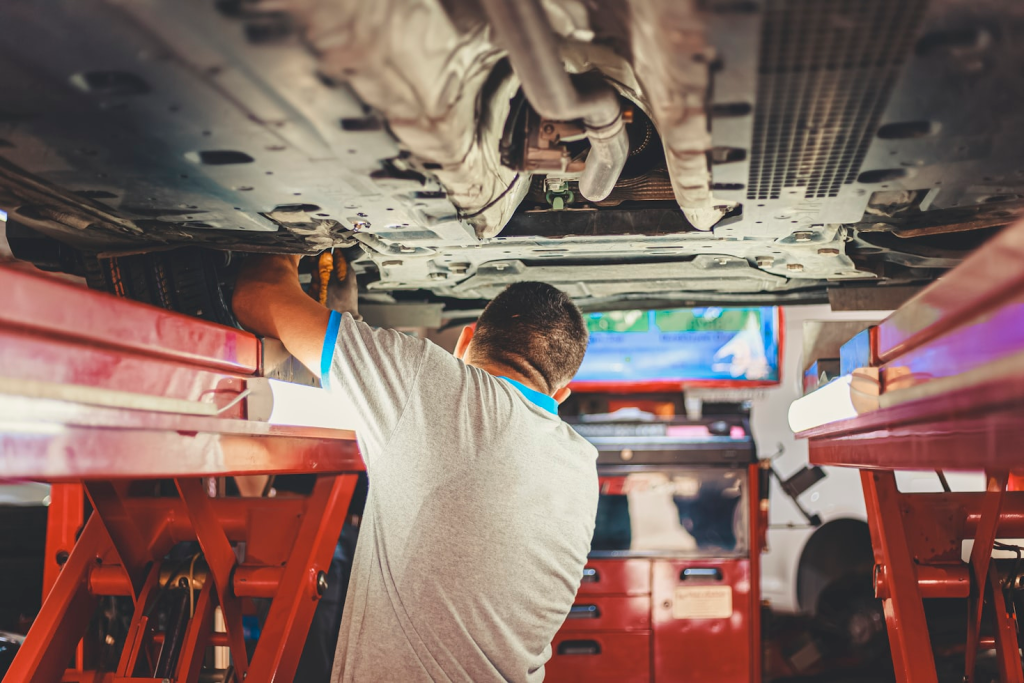
Routine service is an essential investment for any vehicle. While your Ford is built to provide outstanding performance for hundreds of thousands of miles, it does need proper care and attention to deliver the optimum driving experience. Ford's The Works service special is a common offering at most dealerships. Taking advantage of this and other service coupons is the best way to keep your vehicle on the road. Don't wait until you're faced with a repair and potential downtime. Give your vehicle The Works now. more Auto Service Search New Inventory Call Us Today! Stay Ahead of Auto Maintenance With The Works The Works is a popular Ford service special you can routinely find at local dealerships such as Brewster Ford in Brewster, New York. The Works provides essential vehicle care and maintenance in one convenient, money-saving package. With The Works, you'll get everything you need to keep your car in prime condition. If you're unsure where to start with car care, this is the perfect all-in-one option. What's Included in The Works The Works is a comprehensive maintenance package that includes everything you need to keep your car in great shape. You'll enjoy eight essential services all in one visit. Oil Change The Works includes a professional oil change with up to 6 quarts of Motorcraft oil and a new Motorcraft oil filter. If you have an older car, you should have your oil changed every 3,000 miles. With a newer vehicle, you may be able to extend these intervals. Some cars can go 5,000, 7,500, or even 10,000 miles between oil changes. Contact our service team to learn more about the specific recommendations for your vehicle. When you come in for The Works, one of our service technicians will recommend the best motor oil for your vehicle. A synthetic blend or full synthetic motor oil is best for performance. If you have a high-performance vehicle, you want to fuel it properly to deliver optimal efficiency, speed, and horsepower. If you're looking for the most affordable approach to your oil change and high performance isn't a factor, conventional motor oil may serve you well. If your vehicle has more than 75,000 miles on it, a high-mileage motor oil is best. Tire Rotation and Pressure Check Regularly rotating your tires will extend their life. When you change the position of the tires regularly, it helps the tread wear evenly. Maintaining proper tread on your tires is essential for good traction and adequate stopping time on the road. Our technicians will also check your tire pressure and air the tires as needed for optimal performance and fuel efficiency. In general, you should have your tires rotated every 5,000 to 7,000 miles. Brake Inspection Our thorough brake inspection includes the brake pads, shoes, rotors, hoses, motors, assemblies, and pedal. We'll also check your brake fluid to ensure it's at the proper level. This inspection helps us determine whether there are any pending problems with your brakes so we can address these as soon as possible and keep you safe on the road. Fluid Top-Off Your vehicle needs several essential fluids to keep at proper levels. As part of The Works, we check on these fluids and top them off as needed. Some fluids we look at include the power steering fluid, transmission fluid, and windshield washer fluid. Filter Check The air filter removes pollutants, so your engine gets an ample supply of clean air. Over time, the filter will accumulate dust and dirt, diminishing its efficiency and effectiveness. When we give your car The Works, we'll inspect the air filter to see if it needs to be changed. Belts and Hoses Check Your vehicle has several belts and hoses that are essential to safe operation. Serpentine belts operate the power steering pump, alternator, air conditioning compressor, and water pump. Heater and coolant hoses help keep your engine cool so it doesn't overheat and stop functioning. We'll check all these components and recommend replacements as necessary. Battery Test Your car battery will typically last for three to four years. If your battery is dead, you can't operate your vehicle, so it's important to keep an eye on its performance. We'll test your battery and let you know if you should start thinking about a replacement. Vehicle Inspection A full vehicle check-up is included with The Works. This inspection covers any areas of the car that we haven't addressed in the steps above and ensures that you can drive away with full confidence in the state of your vehicle. How The Works Helps You Save Investing in regular maintenance now can help you save money in the future. A vehicle that's properly maintained will last longer, so you won't have to shop for a new vehicle as soon. When you're ready to upgrade, a well-maintained vehicle will have a greater value as a trade-in for your next car. Proper maintenance can also save you from future repair costs. Most issues are much cheaper to prevent than to fix. The Benefits of Using Service Specials Our service specials help you save on the important maintenance and care you plan to invest in. Get the best price possible on all your vehicle's needs with our service specials. In addition to The Works, we also offer various rotating offers for everything from battery tests to tire services. Check out our specials page to see the latest coupons and deals. Cash In on Money Saving Service Specials Now If you're due for vehicle service, don't wait. Schedule your next visit with Brewster Ford now and get this task on your calendar. Our service center is open from 7:30 a.m. to 5 p.m. Monday through Friday and from 7:30 a.m. to 1 p.m. on Saturday. We're committed to providing the best parts and services in Brewster, New York, and the surrounding areas. We'll keep your Ford car, truck, or SUV in prime condition so you can enjoy your vehicle well into the future. Photo Credit: man in gray shirt sitting on red plastic chair by Enis Yavuz is licensed with Unsplash License

White Ford F-150 with white trim

How Much Does A 2023 Ford F-150 Weigh

Ford's F-Series trucks have been America's best-selling vehicles for over four decades, and that trend seems to be continuing in 2023. The figures are largely due to the enduring popularity of the Ford F-150 full-size, light-duty pickup. Ford has continuously improved and upgraded the F-150 to stay ahead of the pack. The 2023 F-150 is the lightest truck among its closest rivals, but it still offers class-leading payload towing capability. Here at Brewster Ford in New York, we've put together a guide to how much the F-150 weighs and how much it can carry and tow. more New Ford F-150 New Ford Trucks Call Us Today! 2023 Ford F-150 Overview Whether you use your truck for work or play, the 2023 F-150's appearance will turn heads and get you or your business noticed. In our Brewster Ford inventory in Brewster, New York, you'll find the F-150 in six main trim levels: XL, XLT, Lariat, King Ranch, Platinum, and Limited. If you enjoy high-octane off-road adventures, the Tremor, Raptor, and all-new Raptor R models are specially equipped for the trails. Depending on the trim, you can choose the F-150 with a two-door regular cab, an extended SuperCab, or the roomy SuperCrew cab. You also have a choice of a long 8-foot bed, a 6.5-foot medium bed, or a 5.5-foot short bed. How Much Does the 2023 Ford F-150 Weigh? The F-150's body and bed are constructed from military-grade, high-strength, aluminum alloy, allowing increased strength without adding extra weight. This enables a greater power-to-weight ratio, helping to achieve the F-150's superior payload and towing capacities. The actual weight of the Ford F-150 depends on your truck's cab and bed configuration as well as the engine and drivetrain choices. You also need to understand the different weight classifications: curb weight, gross vehicle weight rating (GVWR), and gross combined weight rating (GCWR). Curb Weight The curb weight is the weight of the F-150, including fluids such as engine oil, transmission fluid, coolant, and a full tank of fuel. It doesn't include any passengers, cargo, or accessories. Curb weight shouldn't be confused with dry weight, which is the vehicle's weight without any fuel or fluids. The curb weight of the F-150 ranges from 4,021 pounds to 5,740 pounds. GVWR The GVWR is the vehicle's maximum permitted weight, including passengers, cargo, and accessories. This rating affects the vehicle's maximum payload, as carrying more passengers means reducing the amount of cargo. The F-150's GVWR ranges from 6,010 pounds to 7,850 pounds. GCWR When hitching a trailer to your F-150, the GCWR is the total allowed weight of the towing vehicle, passengers, and cargo, along with the weight of the trailer and its load. For the F-150, the GCWR starts at 9,400 pounds, rising to 19,500 for properly equipped vehicles. It's important not to exceed your vehicle's GVWR and GCWR, as that can affect the handling, stability, and safety of your truck. Always consult your owner's manual. F-150 Payload The F-150 Raptor R is built for high-performance off-road thrills and features extra specialist equipment, along with a bigger engine and four-wheel drive. Consequently, it has a lower payload than other trims, with a respectable 1,400-pound maximum capacity. For standard F-150 models, the payload starts at 1,705 pounds when equipped with a regular cab, four-wheel drive, and a 2.7-liter EcoBoost engine. With a regular cab, rear-wheel drive, and the 5-liter V-8, when properly equipped, the F-150 can haul up to an outstanding 3,325 pounds. Models with the SuperCab can carry up to 3,010 pounds, whereas SuperCrew models offer a capacity of up to 2,900 pounds, depending on the engine and drivetrain. Available features, such as onboard scales and smart taillights, tell you when you're near the weight limit or let you view the details on the F-150's touchscreen. F-150 Towing Capacity As with the payload, the 2023 F-150's towing capacity depends on the exact specifications of your truck. For example, with a regular cab and the base engine, you get a maximum towing capacity of 5,000 pounds. When powered by the 2.7-liter EcoBoost, the truck can pull up to 10,100 pounds, and combining the 3.5-liter V-6 with the SuperCab or SuperCrew cab and rear-wheel drive gives the F-150 an astonishing maximum towing capability of 14,000 pounds. Various standard and available towing technologies take the hard work out of hitching, towing, and maneuvering a trailer.  With standard trailer sway control and Tow/Haul driving mode, as well as options such as Pro Trailer Backup Assist, hitch assist, trailer reverse guidance, and a blind-spot information system with trailer tow monitoring, you can tow with confidence. Powerful Engine Options To enable the F-150's awesome payload and towing capacities, Ford offers a choice of six powerful engines. The lineup starts with a 290-horsepower 3.3-liter V-6, which provides 265 lb-ft of torque. You can also opt for a 2.7-liter turbocharged V-6 engine that delivers 325 horsepower and 400 lb-ft of torque. Next up is a turbocharged 5-liter V-8 generating 400 horsepower and 410 lb-ft of torque. There are two versions of a turbocharged 3.5-liter V-6 engine. As standard, it achieves 400 horsepower and 500 lb-ft of torque, while for the Raptor, it's boosted to 450 horsepower and 510 lb-ft. The all-new Raptor R features a mighty supercharged 5.2-liter V-8 that pumps out 700 horsepower and 640 lb-ft. Last up is a highly efficient hybrid powertrain that pairs a turbocharged 3.5-liter V-6 turbo with an electric motor and a battery pack for a total system output of 430 horsepower and 570 lb-ft of torque. All engines are paired with a 10-speed automatic transmission. The F-150 comes standard with rear-wheel drive and offers four-wheel drive as an option, except for the Tremor, Raptor, and Raptor R models, which are only available with four-wheel drive. Are You Ready To Haul Gear? To find the 2023 Ford F-150 that suits your hauling and towing needs, come visit us at Brewster Ford, New York. Alternatively, simply call us at (845)205-7019 or contact us to schedule a test drive of your chosen truck. We can quickly find the best finance deal for your circumstances and get you behind the wheel of an F-150. Photo Credit: Image by RJA1988 licensed with Pixabay License

Tire Rotations Ford Mustang

Why Are Tire Rotations Important?

Your vehicle's tires significantly influence your driving experience. They're essential to how well your car steers, handles, accelerates, and brakes. However, they can wear out and become misaligned over time, leading to inferior ride quality and potential safety issues. Then again, if you maintain your Ford vehicle's tires regularly, you can keep them in good working order. Find out how tire rotations and alignments work and why you should include them in your auto maintenance routine. What Is a Tire Rotation? A tire rotation is a process of switching the position of each individual tire on your vehicle. Generally, rotating your tires should happen every 5,000 miles or according to your vehicle manufacturer's recommendations. It's a good idea to get this service while going in for an oil change. A tire rotation presents a great opportunity to visually examine your tires for signs of damage, measure their tread depth, look at their air pressure, and rebalance them if you notice any vibrations. Why Are Tire Rotations Important? Regularly rotating your wheels helps distribute wear evenly across each tire, increasing their tread life. This is because different positions on your car may need a different give from each tire. For instance, the front tires of a front-wheel-drive car will take a greater proportion of the friction and torque needed for accelerating, turning, and braking. This can result in unpredictable wear on the tires. It's especially vital for new tires to be rotated before 5,000 miles, as tire tread that's deep and fresh is more vulnerable to uneven wear. Preventing uneven tread wear helps keep your tires' tread depth uniform, which leads to more consistent traction and handling across all four tires. This will enhance your vehicle's braking and cornering performance, making it safer to drive. If you own an all-wheel-drive vehicle, evenly worn tires can reduce strain and wear and tear on your drivetrain and help you avoid costly repairs. What Happens If You Drive With Misaligned Tires? Failure to rotate your tires regularly can cause them to be misaligned. Misaligned tires may lead to uneven wear patterns that lower the life span of your tires. Taking your vehicle to a service center for routine tire alignments is an excellent preventive maintenance solution that can make your tires last longer, regardless of whether you have premium or discount ones. You may find your steering wheel leaning to one side or jerking out of your hands when you have alignment issues. If you're struggling to drive in a straight line or holding your steering wheel in one direction to keep your vehicle moving forward, it's a sign that it may be time to get your tires rotated. Even a small steering problem can escalate dramatically when your tires are misaligned. For example, hitting an unexpected pothole can cause you to lose control of your car. Over time, driving on misaligned tires may damage your suspension. As a result of alignment issues, your suspension system is likely to experience excessive stress on one side, causing it to wear out faster than on the other side. Getting a tire rotation or realignment is much more affordable than replacing your suspension. What Tire Rotation Pattern Should You Use? The best tire rotation pattern for your vehicle depends on what type of tires you have, what kind of drivetrain your car is equipped with, whether you're using directional or non-directional tires, and whether or not the size of your front and rear tires are the same. The following are the recommended tire rotation patterns for different types of tires and vehicles: For Non-Directional Tires of Uniform Size Rearward cross: The rearward cross pattern may be suitable for your vehicle if it's rear-wheel, four-wheel, or all-wheel drive. The front tires are moved to the rear axle on the opposite sides, while the rear tires are brought forward and remain on the same side. X-pattern: The X-pattern is recommended if you own a front-wheel-drive vehicle, such as a sedan or lightweight truck. All tires are swapped diagonally, meaning they're repositioned from one axle to the opposite and switched from one side to the other. Forward cross: The forward cross pattern is commonly used on front-wheel-drive cars. The rear tires are diagonally repositioned so that they're on the opposite sides of the front axle, and the front tires are moved back directly. For Non-Directional Tires of Uniform Size and With a Full-Size Spare Rearward cross (four-wheel or rear-wheel-drive cars): The spare tire goes to the right side of the rear axle, while the rear tires are moved up directly to the front. The left front tire is now your new spare, and the right front tire is switched diagonally to the opposite side of the rear axle. Forward cross (front-wheel-drive vehicles): The rear tires are repositioned to the front on the opposite sides, while the right side of the front axle becomes the new spare tire. The front left tire is moved directly back, while the spare occupies the right side of the rear axle. For Directional and High-Performance Tires Side-to-side: The side-to-side pattern is ideal if your vehicle has high-performance tires of different sizes on the front and rear axles. The tires stay on the same axle and swap sides with their same-sized partner. Front-to-back: This tire rotation pattern is used for vehicles with directional tires. The tires are switched to a different axle but stay on the same side of the car. If you're looking for top-quality tire rotation or alignment services in Brewster, New York, consider taking your vehicle to Brewster Ford. Serving Brewster, Peach Lake, Lake Carmel, Croton Falls, Mahopac, Patterson, and Katonah, our dealership has a Ford-certified service center that provides the full range of tire services, including tire rotations and tire replacements. No matter which Ford model you own, you can count on our factory-trained technicians to help you keep your tires performing at their best. Contact us today to schedule an appointment. Photo Credit: 2015 Ford Mustang 5.0 GT by Michel Curi is licensed with CC BY 2.0