

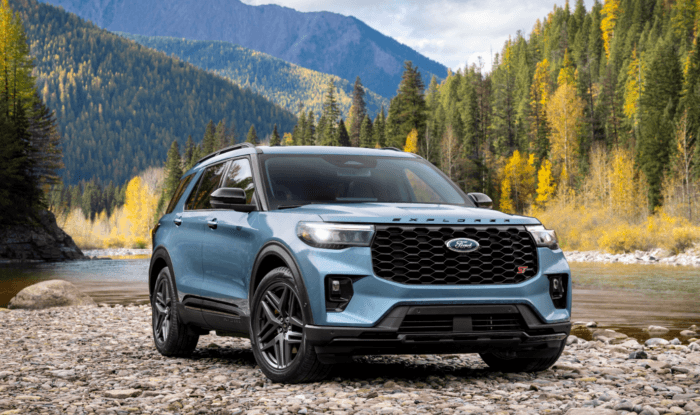
The 2025 Ford Explorer and Toyota Highlander are battling it out for your family’s driveway spot in Brewster, New York. These three-row SUVs offer the space, safety technologies, and flexibility that busy families need for school runs and weekend getaways. They’re both solid choices, but they definitely aren’t twins. Let’s look at what makes each one exceptional — from power and space to technology and value — so you can figure out which one fits your crew best.
Performance and Powertrain Analysis
If you’re trying to decide whether the Ford Explorer or Toyota Highlander matches your needs, start by considering powertrains and capability.
Ford Explorer
Ford gives you two power options. The 2.3L EcoBoost, standard on all but the ST trim, cranks out 300 horsepower and 310 lb-ft of torque, hitting 60 mph in about 6 seconds. This turbocharged I-4 handles highway passing and city jaunts confidently with reasonable fuel efficiency.
A 3.0L EcoBoost V-6 — standard in the ST and optional for the Platinum — cuts the 0-to-60 mph sprint time to 5.2 seconds with 400 horsepower and 415 lb-ft of torque. Both engines use a 10-speed automatic transmission and come in rear- or all-wheel drive. You get the same towing capacity with either engine, but that V-6 makes pulling a boat to Lake Mahopac much less stressful.
Toyota Highlander
Toyota takes the efficiency route with its standard 2.4L turbo I-4 making 265 horsepower and 310 lb-ft of torque, paired with a six-speed automatic transmission. It’ll handle grocery runs and school pickups, but load it up with kids and camping gear, and you might wish for more power. The front-wheel-drive setup helps with gas bills but can’t match the balanced feel many drivers prefer. In sprint trials, the Highlander takes about 7.2 seconds to hit 60 mph.
Head-To-Head Performance Verdict
The Explorer’s edge goes beyond raw power. It sits on a rear-drive platform, while the Toyota uses front-drive architecture. This gives the Ford better weight balance and more confident handling on twisting Hudson Valley back roads.
Both SUVs can tow 5,000 pounds — plenty for weekend trips to the Catskills. But the Explorer’s extra muscle makes towing feel like less work, especially on hills around Brewster. And that horsepower boost helps when you’re merging onto I-684.
Interior Space and Family Comfort
The Explorer offers slightly more cargo space than the Highlander. Behind the Ford’s third row, you’ll find 16.3 cubic feet, compared to 16 cubic feet in the Toyota. The Explorer offers 85.8 cubic feet overall, while the Highlander gives you 84.3.
Both SUVs incorporate appealing interior materials. Ford uses padded plastics, leather trim, realistic-looking simulated wood, and metal speaker grilles. The Explorer and Highlander each offer 10-way power driver seats with memory, heating, and cooling.
Seating Capacity and Configuration
While Toyota designed a functional three-person bench seat for the back of the Highlander, the Explorer’s third row sits close to the floor, so it’s best suited for two people. That means the Highlander can carry eight passengers while the Explorer tops out at seven.
The Highlander offers slightly more legroom, though the difference is under 5%. For most families, either one works fine for daily driving, but Toyota’s extra seat and more comfortable third row give it the edge for extra passengers.
Technology and Infotainment Systems
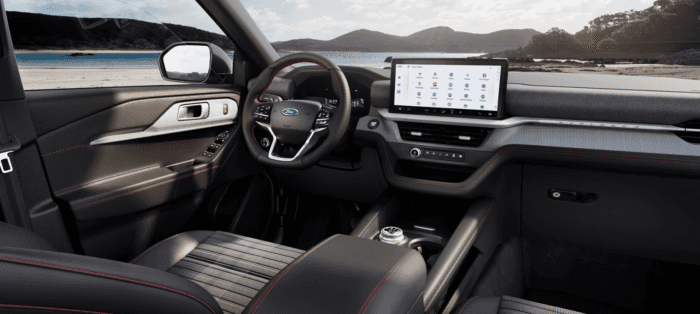
The Explorer pulls ahead with larger screens and better audio. Ford’s 13.2-inch display gives more screen space than Toyota’s 12.3-inch setup, and both SUVs run their brands’ latest software. The Explorer’s bigger screen makes using maps, climate controls, and music easier for you or your front-seat co-pilot to manage. You access Ford’s climate controls through the touch screen, while the Toyota has physical knobs, which are sometimes easier to manipulate when you’re focused on driving.
Music lovers will hear the difference immediately. Ford’s 14-speaker Bang & Olufsen system sounds richer than Toyota’s 11-speaker JBL setup. Both SUVs sport 12.3-inch digital gauge clusters, but Ford’s BlueCruise feature is the real game-changer. It lets you drive hands-free on most major highways in the U.S. and Canada. Note that BlueCruise costs $49.99 monthly after a free 90-day trial.
Safety Ratings and Reliability Comparison
Both family haulers earn top marks in crash tests. The Explorer was awarded the Insurance Institute for Highway Safety (IIHS) Top Safety Pick+ for 2022 models, Top Safety Pick for 2023, plus five stars from the National Highway Traffic Safety Administration (NHTSA). The Highlander matched with an IIHS Top Safety Pick+ and five NHTSA stars for 2021 and 2022 models.
Reliability tells a different story: according to RepairPal, the Ford Explorer has a reliability rating of 3.5 out of 5, placing it slightly below many midsize SUV competitors. Toyota’s Highlander earns a rating of 4, with substantially lower annual repair costs.
Fuel Economy and Efficiency
Fuel efficiency slightly favors the Toyota, though both models offer suitable mileage for family commutes. While you’ll see slight variations among trims, most offer these ratings:
- Highlander: 22 mpg city/29 mpg highway
- Explorer 2.3L I-4: 20 mpg city/29 mpg highway
- Explorer 3.0L V-6: 18 mpg city/25 mpg highway
Find Your Perfect Family SUV at Brewster Ford
Which SUV deserves your garage space? It comes down to what matters most to your family. The Toyota Highlander offers seating for eight passengers, slightly better fuel economy, and legendary reliability. But if you crave driving excitement alongside family practicality, the 2025 Ford Explorer wins on raw power, luxury touches, and smooth drivability.
Ready to feel what 300 horsepower and rear-wheel drive can do for your family trips? Drop by Brewster Ford for a test-drive. Our team understands what Hudson Valley families need and can walk you through the Explorer’s trims and features. Come see why families choose the Explorer.
Images from ford.com
Connect with us


- July 2026
- June 2026
- May 2026
- April 2026
- March 2026
- February 2026
- January 2026
- December 2025
- November 2025
- October 2025
- September 2025
- August 2025
- July 2025
- June 2025
- May 2025
- April 2025
- March 2025
- February 2025
- January 2025
- December 2024
- November 2024
- October 2024
- September 2024
- August 2024
- July 2024
- June 2024
- May 2024
- April 2024
- March 2024
- February 2024
- January 2024
- December 2023
- November 2023
- October 2023
- September 2023
- August 2023
- July 2023
- June 2023
- May 2023
- April 2023
- March 2023
- February 2023
- January 2023
- December 2022
- November 2022
- October 2022
- September 2022
- August 2022
- July 2022
- June 2022
- May 2022
- April 2022
- March 2022
- February 2022
- November 2021
- October 2021
- September 2021
- January 2021
- February 2017
- January 2017
- December 2016